
[I do not identify as a Christian in any traditional sense of the word (and many Christians would not have me, even if I did). Still, there will be a lot of a speaking of, about, in and through Christianity in this piece.]
I was taught to pray long before I ever stepped foot in a church.
From the days of my earliest memories.
Every night before bed:
“Now I lay me, down to sleep,
I pray the Lord my soul to keep.
If I should die before I wake,
I pray the Lord, my soul to take.
God bless Mommy, Daddy, my brother and me,
All my friends, all my relatives.
Amen.”
Did I even know what dying was?
What a soul was?
What the soul’s other post-death options might be?
Why my parents wanted me to believe that God was my best bet for my soul’s posthumous care?
When I was little I would often lie in bed at night and try to figure out where God came from.
If God created everything, what created God?
Such pondering gave me a frighteningly empty feeling in my gut as if all of existence had melted into a black hole and was sucking me in. I would struggle to breathe, to get my brain to change the subject, to think of anything else.
On one night a year, Christmas Eve, my parents would read to me from a children’s book about the Nativity.
On Easter, they focused on the Eastern bunny/basket of candy aspect of the holiday and skipped the Jesus-getting-nailed-to-a-cross-and-coming-back-to-life-later bit entirely, conveniently eliding any reference to death and its permanence or impermanence.
I don’t know if it’s because my parents finally wanted us to be soaked in religion, rather than just spritzed with it once a year, or because Southerners seemed more offended by our not going to church than by the fact that we were Yankees, but after we moved to Georgia when I was in very early elementary school we started attending a United Methodist Church, a choice of venue seemingly based on it being where my Girl Scout troop met.
I learned later that the older (and younger) white members of the church complained because we had a Black troop leader and Black girls in the troop.
Revisionist history says we left in response to those complaints, but we really didn’t. We stayed a while.
I looked it up, out of curiosity, to see if that place is still standing
Ironically, it appears that the church’s membership is entirely Black now.
We went to a different United Methodist Church when I was nearing the end of elementary school and stayed on until I was partway through high school. My parents made me go to Youth Group on Sunday nights and I used to skip the first half and go to the Krispy Kreme on the corner or the Waldenbooks or the Trick Shop across the way with one or two others and come back in time for Vespers in the sanctuary, where the lights were dim and the youth minister would probably say something profound, but non-committal — think, “life is tough, but that’s okay, something-something-Jesus” not “get saved, or else”) — though I don’t really remember much about that part, and then he’d play James Taylor on a boom box and various kids in tight-rolled jeans or Mr. Zog’s Sex Wax (“The Best for Your Stick Since 1972”) shirts would go up to the altar and kneel down and cry about how shitty it is to be a teenager, probably, or their most recent break-up, and sometimes I would, too, not gonna lie, and at the end he’d tell us to hug two people or three people or five people and that was the part I liked, because I wasn’t really into hugs, generally, and would never have solicited them from the far more socially superior members of the youth group (which was pretty much everyone in the youth group), but there was something about the low stakes of “well, we *have* to hug each other” that made it kind of nice, really.
Even though we skipped part of youth group each week,
none of the adults ever asked where we were or confronted us about it.
I don’t think we were that slick; I think they just didn’t care.
I’m UU now.
A few Sunday’s ago, during my church’s online Zoom-based “coffee hour” (which offers a time for members to chat with one another around a generally light topic in randomly assigned breakout rooms), our breakout room prompt was to discuss our favorite spring holiday tradition. Most of the attendees in my small group spoke of Easter traditions–dying eggs, hiding candy, baking special cakes, etc.
Though I had some memories from Easter growing up that I could share–
hiking to the top of Stone Mountain for a sunrise service, coming back down and meeting other church members at a restaurant for breakfast (all of us probably driving the wait staff nuts) before spending the day at church for three different Easter services because my parents sang in the choir, trying not to eat the snacks that were set out for the choir members, sneezing from my allergy to Easter lilies, hoping for gumball eggs in my Easter basket but biting in and finding Whoppers instead and having to spit them out…
–I must admit it is a holiday that I struggle to connect with in my adulthood.
Not the eggs and bunnies and baskets part.
The “died for your sins” part.
The resurrection part.
I can usually find some symbolism to embrace, even as I feel long distant from the more literal parts. This year it’s been trickier.
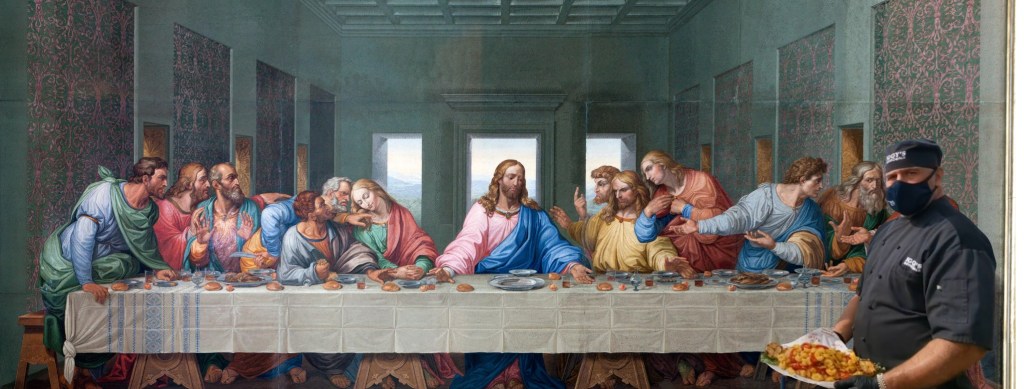
When I was in that one Methodist youth group when I was a teenager, we always had a “Youth Week” over the summer. Five nights of mostly wholesome, youthful chaos. On the last night, we’d have communion, but not in the sanctuary. The lights were dim (as per all of the youth group’s “serious” moments), and there’d be a (very leavened) loaf of bread instead of communion wafers.
We would each tear off our own chunk of bread as it was offered around and there was something about the act of tearing from a communal source that felt very meaningful at the time. Something unifying.
Every other day I was “other,” “awkward,” “too much,” “less than,” “outside,” but something about that ritual made me feel different, somehow. Like for a moment, I belonged. Sincerely belonged.
I remember being appreciative of the bits that felt sincere and very disillusioned by pretty much everything else.
When my brother was in college pursuing vocal performance, my family would drive up to hear him perform in Brevard, North Carolina during the summer. I found it deeply boring, except for when the sopranos would hit the high notes and the bats in the rafters of the partially covered outdoor venue would stir and fly around.
On one of those trips we were still in Brevard on a Sunday morning, so my mother suggested that we go to church. It was a Methodist church and it was the first Sunday of the month, which meant it was communion Sunday. During the service when it was our row’s turn to go to the front to partake in the ritual, I stayed seated, much to my mother’s chagrin. She was insistent, finding my behavior embarrassing — What would people think? — but I stayed put.
I couldn’t do it. I didn’t believe in it anymore. It didn’t seem right to participate in a ritual I didn’t believe in, just to fit in. To avoid being looked at funny or whispered about.
(Besides, we would never see *any* of those people again, so what did it matter what they thought? Were they going to follow us back to Georgia, taunting us all the way for my abstinence?)
I have gone back and forth on communion over the years. I don’t partake now, and would feel uncomfortable doing so, but I did in my twenties.
The following excerpt is from an essay I wrote for a class two years ago on the topic of a risk we’d taken that had paid off in the end. I wrote about my decision to break the rules at the Church of God I attended (back in my evangelical Christian twenties) and serve communion to the 5th and 6th grade Wednesday night Bible study class I was teaching, even though non-Pastors weren’t actually permitted to do so:
My time with the 5th and 6th grade class was going along swimmingly until it came time to prep for an upcoming lesson about the Last Supper. I knew the only way I could stay true to the immersive and interactive spirit of the class that the children responded so positively to was to actually have communion in class. Though I tried at first to convince myself that there must be some other way, I knew there wasn’t. I couldn’t ask the pastor to serve communion, as he would be leading Wednesday night worship at the same time. No, it was up to me. There was no other way.
Resigned to my fate, I found myself in the checkout line at the local Publix with a cart full of mini matzos, bottles of grape juice, and packs of tiny Dixie cups.
When the Wednesday night of the Last Supper class rolled around, I considered chickening out, fearful of the consequences if the pastor caught wind of what I was about to do. Still, I pushed forward, packing up the juice, crackers and tiny cups and loading them into our truck. “If anyone sees me, they’ll just think I brought snacks,” I told myself, only half-convinced I could pull it off. When I arrived at church, I ferried my contraband inside, my heart racing…
When class had started and the time came, I handed each child a little matzo and recited, “And Jesus said, ‘Take, eat, this is my body…'” I poured each child a small cup of grape juice. “‘Take, drink, this is my blood poured out for you. Do this in remembrance of me…'” When each child had received Communion, one 5th grader raised his hand excitedly, “Miss Krista,” he exclaimed, looking as though he might leap from his chair, “I dreamed last night that we had Communion in here and today we really did!”
I was blown away. Humbled. What if I had chickened out?
That 5th grader was the only Black child in the class. The church’s congregation, itself, was mostly white, with the exception of the Black children and adults who would come in on the church bus from the surrounding neighborhoods. On Sunday morning the Black congregants would sit in the front three rows on the right, while most of the white folks sat everywhere else. And the congregation would pat itself on the back for “evangelizing the community” and seeing the community as “a mission field.”
I believe the church’s demographics have shifted somewhat since the days of my attendance in my twenties, but I will admit to a fresh curiosity about the impact of the shift on the church’s message.
According to a Facebook Live recording I found from last June, the current pastor of that church went up to Minneapolis after George Floyd was murdered, armed with a Bible (“instead of a protest sign,” he’s proud to point out), ready to provide answers. Ready to see a “revival.” In the video, he appears to be confused and disappointed when no one wants to talk to him. When people just want to grieve in peace.
A sermon of his, posted to Facebook when he was back home a few weeks later, excoriated those who thought prayer wasn’t enough to fix everything.
I’m moved by the non-staged moments in the Minneapolis video. The moment when you can see the pastor’s confusion. The moments when his response is inadequate to everything around him. I wonder if for a split second he considers surrendering to what is rather than what he’d hoped there would be.
In the second video, I watch the cockiness of the pastor as he struts about the pulpit, weeks after having the opportunity to not have to have all the answers, but now insisting on having them anyway, and I bristle.
Why did I put myself through watching those videos? Curiosity? Judgement? I will admit to judging myself from time to time for the hurt and harm I caused with my own former stridency.
Was there anything from that time period that would connect with the way I exist in the world now?
I remember turning to deeply prescriptive faith in my twenties when I was rudderless and desperate for something to tell me exactly. what. to. do. There’s a safety in thinking you have all the answers.
A dangerous sort of safety.
May I resist thinking I am better than that pastor.
Somewhere, somewhere in there, in those moments in Minneapolis, I can recognize how desperately, desperately he is clawing back to the comfortable spot. The place where the answers are. A place I clawed to. Clung to.
He’s likely just as scared as anyone else. His role just doesn’t allow him to admit it.
Though doubt is a key element in faith, faith as it is practiced and prescribed in such traditions punishes doubt.
May I awaken each day, surprised and humbled by what I do not know.
May I resist thinking I have it all figured out.
That I know better than.
“If you have come here to help me, you are wasting your time. But if you have come because your liberation is bound up with mine, then let us work together.”
–often attributed to Lilla Watson, along with an Aboriginal rights group she worked with in the 1970s
Where do liberation and faith intersect? How do faith, spirituality, and other ways-of-being intersect with an acknowledgement of a need for collective liberation? Temporal liberation?
This is where I wrestle with (and even reject) the impulse to label three days of Biblical events as freedom from sin and death.
What if Jesus didn’t “die for our sins” or to give us a pass to heaven or to make us “right with God”?
What if Jesus didn’t die so we can eschew the temporal?
There are myriad ways in which eschewing the temporal is a loss of the soul.
What do you gain if you manage to live an inoffensive life just beyond the reach of the cruelty of the state, while you watch your brothers and sisters being violently oppressed by it daily?
You can keep your eyes so fixed on heaven, you trip over the bloodied bodies of your brothers and sisters here on the ground.
“The solution which Jesus found for himself and for Israel as they faced the hostility of the Greco-Roman world, becomes the word and the work of redemption for all the cast-down people in every generation and in every age. I mean this quite literally. I do not ignore the theological and metaphysical interpretation of the Christian doctrine of salvation. But the underprivileged everywhere have long since abandoned any hope that this type of salvation deals with the crucial issues by which their days are turned into despair without consolation. The basic fact is that Christianity as it was born in the mind of this Jewish teacher and thinker appears as a technique of survival for the oppressed. That it became, through the intervening years, a religion of the powerful and the dominant, used sometimes as an instrument of oppression, must not tempt us into believing that it was thus in the mind and life of Jesus.“
– Howard Thurman in Jesus and the Disinherited, “Chapter One: Jesus–An Interpretation,” emphasis added.
If Jesus existed in any way close to what is captured in the various (and sometimes contradictory) versions of his life from the Christian scriptures; if Jesus existed and died for *anything,* I am inclined to think that his death provides an opportunity for us to open our eyes to those we have stubbornly refused to see. To tear down preconceived and “holy” notions of who and how we are allowed to love and care and be. But, also, to open our eyes to systems that are deeply oppressive and to the ways in which too many of us have been complicit in that oppression.
But if that’s the “good news,” what does that look like?
And if that’s the “good news,” what does it sound like?
It sounds like speaking truth to power.
It sounds like the silence of recognizing when you are the power that needs to hear the truth.
“Too often the price exacted by society for security and respectability is that the Christian movement in its formal expression must be on the side of the strong against the weak. This is a matter of tremendous significance, for it reveals to what extent a religion that was born of a people acquainted with persecution and suffering has become the cornerstone of a civilization and of nations whose very position in modern life has too often been secured by a ruthless use of power applied to weak and defenseless peoples.”
– Howard Thurman in Jesus and the Disinherited, “Chapter One: Jesus–An Interpretation”
(Check out this posthumous piece on Cone, which deftly responds to the controversies surrounding his theological assertions.)
kfw 2021
 Undusted Corners